ML/AI, CV
Microsoft Just Told Us Where the AI War Is Moving - Agents and Infra
For the last two years, most of the AI industry has obsessed over one question: who has the best model?
GPT. Claude. Gemini. Llama. DeepSeek. Benchmarks moved. Context windows grew. Models became cheaper, then faster, then capable of reasoning for longer.
But something more important is starting to happen underneath all of that.
On 2 September 2026 Microsoft announced its first major reorganisation of its reportable business segments since 2015. Three segments become two. One of them is called Devices and Consumer. The other is called Agents and Infra.
That might sound like accounting. It isn't. It may be one of the clearest signals yet of where enterprise computing is heading.
What Microsoft actually said
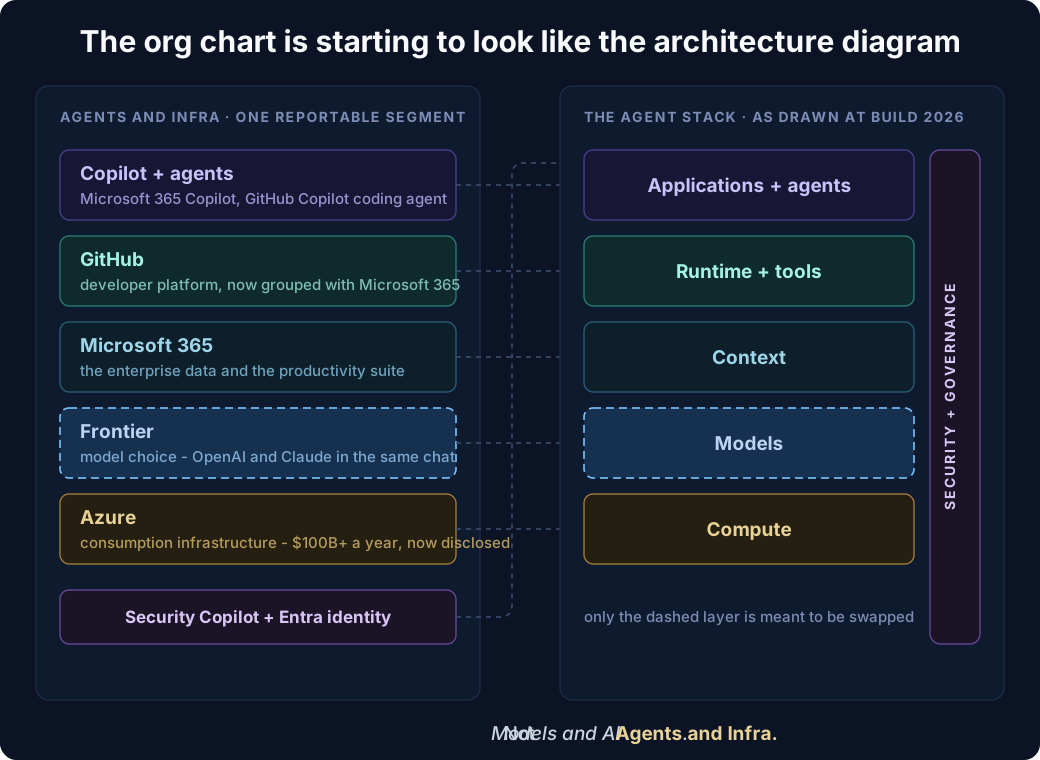
The new Agents and Infra segment takes in Azure and the Microsoft 365 cloud products, productivity and server licensing, industry solutions, and Frontier and support services. Azure itself gets reported as a dollar figure for the first time - it passed $100 billion in the fiscal year that ended in June - and it becomes a purer consumption-based infrastructure business, because GitHub, Security Copilot and the healthcare cloud move out of the Azure number and sit alongside Microsoft 365 instead.
So inside one segment you now have the compute, the enterprise data, the developer platform, the productivity suite, the security tooling and the agents. Satya Nadella's statement on the change said AI is "blurring the boundaries between our products and reshaping our business models." Earlier in the year, Microsoft's earnings materials described its two priorities as building the infrastructure for the agentic era and building agentic systems on top of it, and said those two layers reinforce each other.
The organisational chart is starting to look like the architecture diagram. And the architecture is changing.
Why a segment name matters
Companies do not rename how they report revenue to investors for marketing reasons. A reportable segment is how the CFO thinks about the business - how resources are allocated, how products are measured, and what is sold together. Putting Azure, Microsoft 365, GitHub and the agents into one line tells you what Microsoft believes customers are actually buying.
The application is becoming an agent
Traditional enterprise software looked roughly like this:
User → Application → API → Database
Then generative AI added another layer:
User → Application → LLM → API → Database
But agents change the architecture again. An agent doesn't simply generate an answer. It can interpret an objective, create a plan, retrieve context, choose tools, call APIs, execute code, interact with other agents, keep memory, retry failed actions, make decisions - and keep working without constant human input.
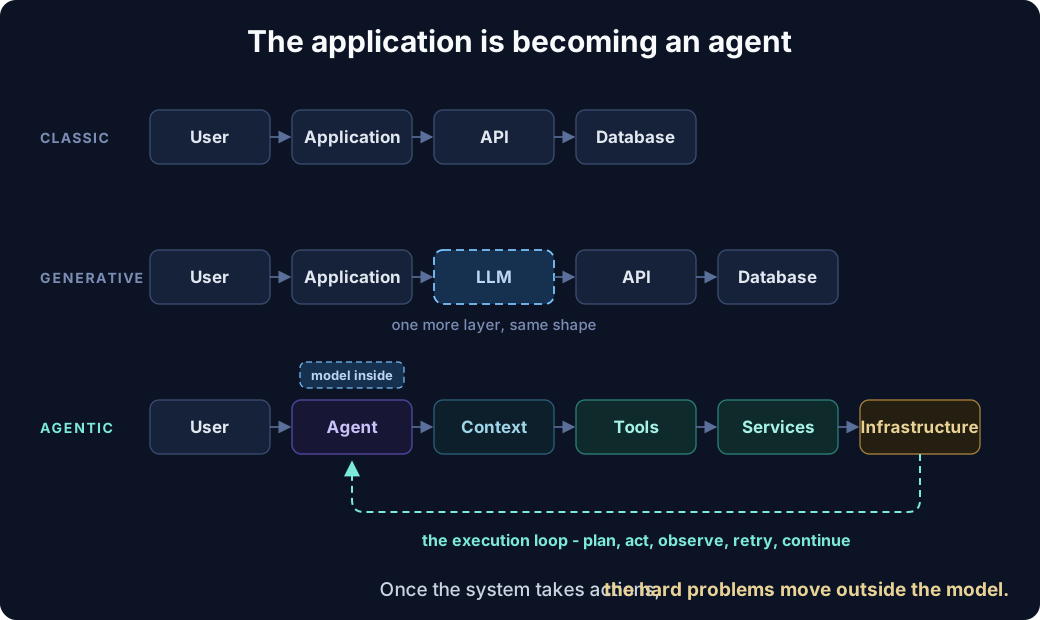
The model becomes one component inside a much larger execution loop. The emerging shape is closer to:
User → Agent → Context → Tools → Services → Infrastructure
with a loop around the entire thing. That distinction matters enormously. Once AI starts taking actions rather than generating text, almost every difficult problem moves outside the model. This is the shift traced in the model is not your agent: the loop, not the model, is the application.
The model is becoming replaceable
Consider what is already happening on enterprise AI platforms. Applications increasingly support multiple models. The same agent might use a fast model for classification, a reasoning model for planning, a coding model for software tasks, a specialised model for security review and a local model for sensitive workloads.
Microsoft 365 Copilot is itself the worked example. It now describes itself as model-diverse by design, with Claude available in mainline chat alongside OpenAI's models through the Frontier programme. Microsoft's own flagship agent does not have a single model underneath it.
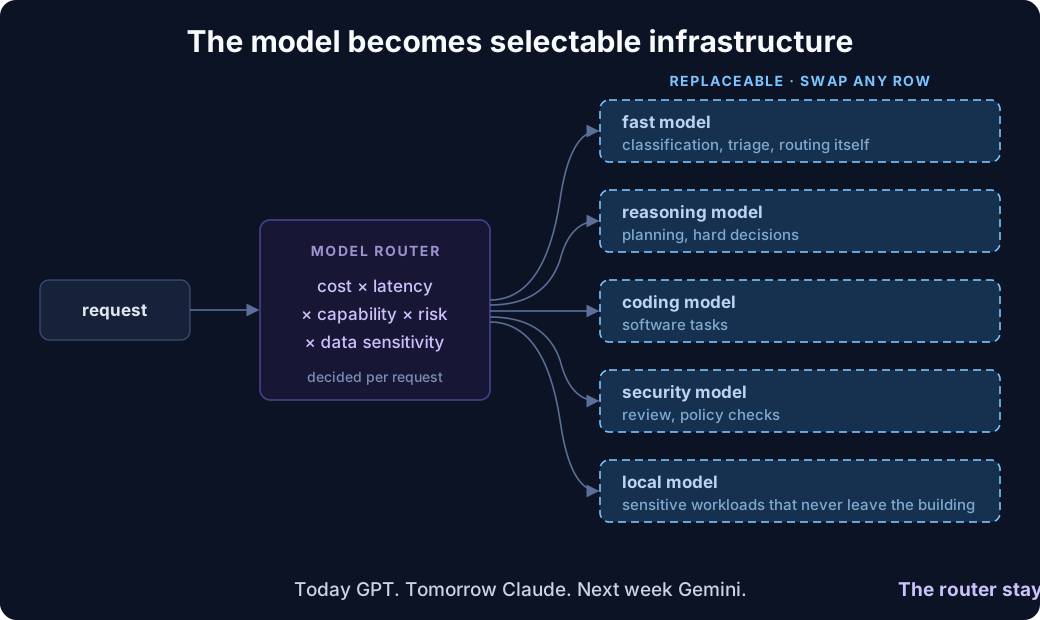
The model becomes selectable infrastructure. Today it might be GPT. Tomorrow Claude. Next week Gemini. Eventually an organisation routes each request dynamically on:
cost × latency × capability × risk × data sensitivity
That makes the model incredibly important. But it also makes it increasingly replaceable. The harder thing to replace becomes everything surrounding it - which is the whole argument of the AI war is moving down the stack, and Microsoft has just put a revenue line on it.
The agent harness becomes the application runtime
Once agents start doing meaningful enterprise work, organisations need something controlling them. Call it an agent runtime, an agent harness or an orchestration layer. The name matters less than the responsibilities.
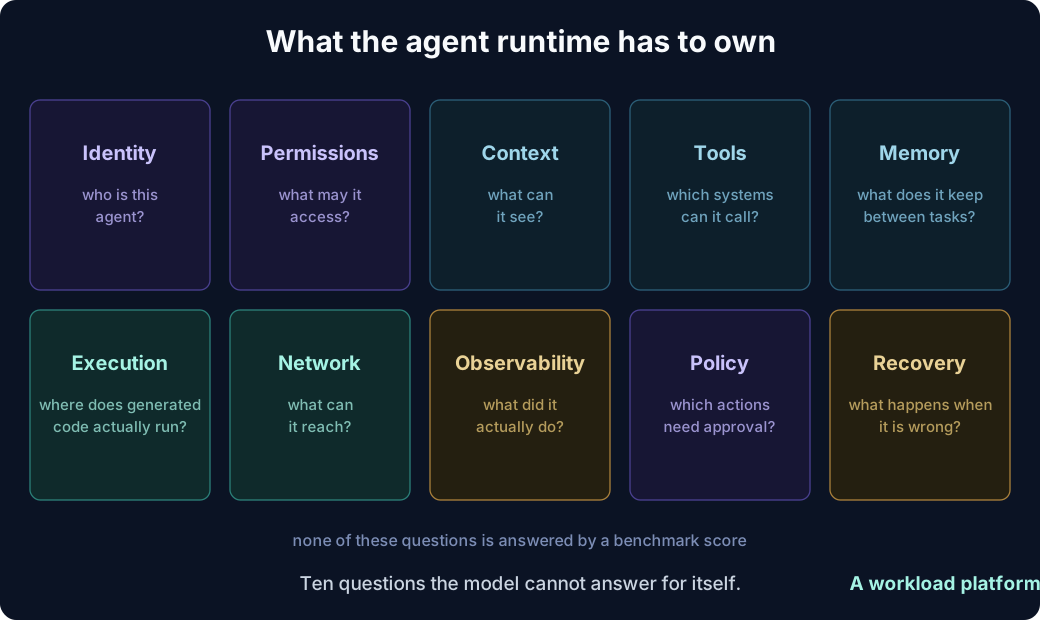
- Identity - who is this agent?
- Permissions - what is it allowed to access?
- Context - what information can it see?
- Tools - which systems can it call?
- Memory - what does it remember between tasks?
- Execution - where does generated code actually run?
- Network access - what external systems can it reach?
- Observability - what actions did it take?
- Policy - which actions require approval?
- Recovery - what happens when an agent makes a mistake?
At that point the architecture begins to resemble something infrastructure engineers already understand very well: a workload platform.
Agents are becoming workloads
We used to deploy applications. Then containers. Then Kubernetes workloads. Now we are beginning to deploy something different: autonomous workloads capable of deciding what they do next.
That creates an entirely new infrastructure problem. A traditional workload executes instructions written by a developer. An agent interprets a goal and determines its own sequence of actions. That changes the security model.
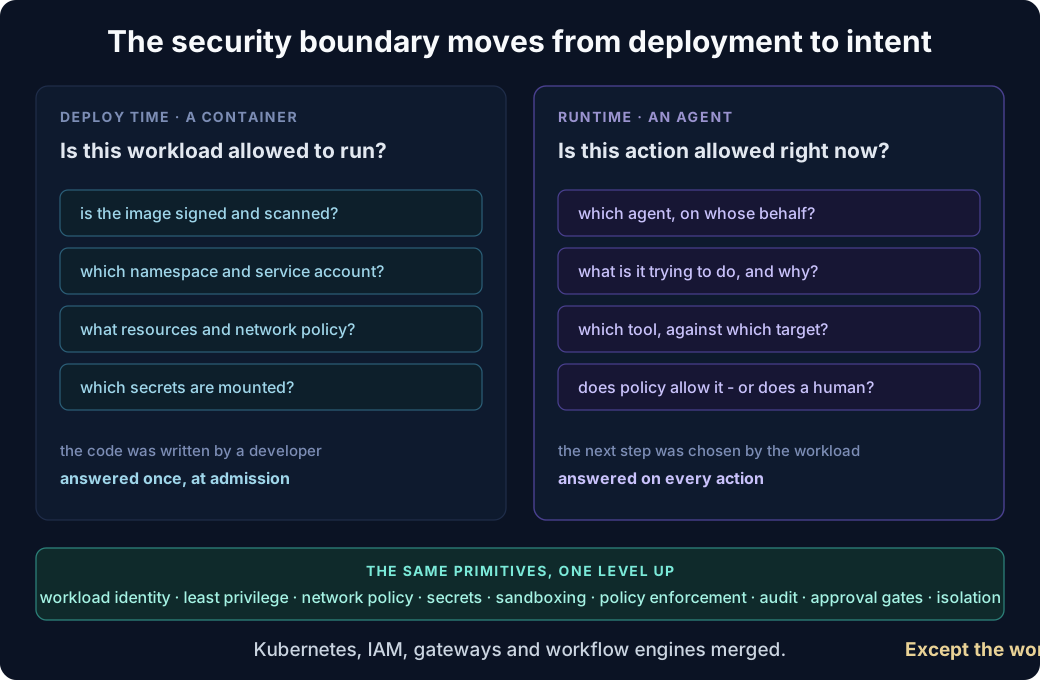
The infrastructure can no longer only ask is this workload allowed to run? It must increasingly ask is this particular action allowed right now? The security boundary moves from application deployment toward runtime intent.
Which means agent platforms need concepts familiar from cloud-native infrastructure: workload identity, least privilege, network policy, secrets management, sandboxing, policy enforcement, audit logs, human approval gates and execution isolation. The AI platform of the future starts looking suspiciously like Kubernetes, IAM, API gateways and workflow engines merged together.
Except the workload can reason. That is why Kubernetes is turning into an AI workload orchestrator, and why the sensible starting posture is to assume the agent can escape.
Reasoning is not a privilege
The fact that an agent can decide what to do next is not a reason to grant it broader access. It is the reason to grant it narrower access, per action, with a record. Treat autonomy as a threat model, not a feature flag.
AI infrastructure is becoming the moat
This is why Microsoft's terminology is interesting. Not Models and AI. Agents and Infra.
At Build 2026, Nadella laid out the agent stack in five layers - compute, models, context, tools and runtime - with security and governance wrapped around all of it. The reorganisation groups the businesses that map onto those layers into a single segment. The model alone isn't the platform. The platform is the whole column, and value accumulates across it.
Nadella made the same point in a different register in June, in his essay on token capital: the real opportunity is not in picking the best model but in building a learning loop on top of models where human capital and token capital compound. In January at Davos he had already reframed the metric of AI infrastructure as tokens per dollar per watt - useful output, not deployed capacity.
Microsoft isn't alone in recognising this. The AI industry is racing to secure compute because running persistent agents changes infrastructure economics dramatically. Reuters reported this week that Anthropic signed a $35 billion cloud deal with Nvidia-backed Lambda, a week after a $45 billion agreement with Nscale, and that it began aggressively pursuing cloud agreements after running into a supply crunch earlier this year as usage climbed.
The conversation is changing from how many GPUs do you have? to how much useful agent work can those GPUs produce?
The next cloud platform battle
The first cloud battle was about virtual machines. Then containers. Then managed services. The next one may be about agent execution.
Cloud platforms will compete over who provides the best environment for agents to discover tools, access enterprise context, authenticate safely, execute code, coordinate with other agents, maintain state, switch between models, observe every action and enforce organisational policy.
Models will still matter enormously. But the deeper competitive advantage may be the environment in which those models operate.
- AWS has compute, IAM and an enormous service ecosystem.
- Microsoft has Azure, Microsoft 365, GitHub, enterprise identity and enterprise data - now reported as one business.
- Google has infrastructure, Gemini, Workspace and enormous data systems.
The model race isn't disappearing. It's being absorbed into a much larger platform race.
The architecture diagram is changing
For architects, this means we should probably stop drawing AI systems as Application → LLM. That diagram is already becoming obsolete.
A more realistic architecture runs from the application down through the agent runtime, planning, context and memory, a model router, a tool gateway, enterprise services and a sandbox - with identity, policy, observability and audit wrapped around the entire system. The LLM is still critical. But it is no longer the architecture. It is a component inside the architecture.
We are moving down the stack
The first phase of generative AI was about intelligence. The second phase is about execution. And execution forces the industry down the stack.
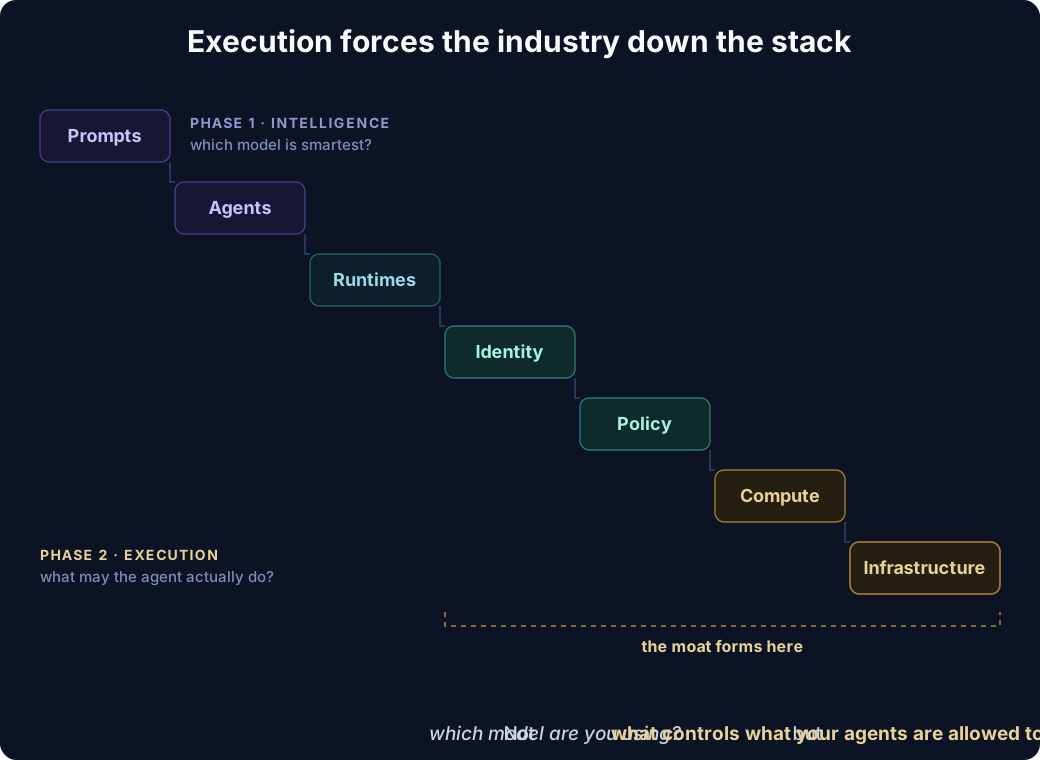
Microsoft calling its new business segment Agents and Infra isn't proof that this architecture has won. But it is a remarkably clear signal.
Because eventually the most important question in enterprise AI won't be which model are you using? It will be: what infrastructure controls what your agents are allowed to do?
The model may increasingly be replaceable. The infrastructure around the model is becoming the moat.