ML/AI, CV
CAS Is Not Obsolete in the Age of Agentic AI - It May Be More Important Than Ever
Agentic AI is changing how software behaves.
Instead of waiting for a user to issue every instruction, AI agents can interpret goals, plan tasks, call tools, write code, search for information, evaluate results and decide what to do next.
This naturally raises a question:
If AI can reason about mathematics, do we still need Computer Algebra Systems?
The answer is yes.
In fact, as AI systems become more autonomous, deterministic systems such as a CAS may become even more important.
AI can reason. CAS can verify.
Large language models are remarkably good at explaining mathematics.
They can interpret a word problem, identify the likely approach, generate examples, explain concepts in different ways and guide a learner through a solution.
But language models are probabilistic systems.
A model may generate:
x = 7
because that answer appears consistent with the reasoning it generated. Not because anything checked it.
A Computer Algebra System approaches the problem differently. It manipulates the mathematical expressions according to explicit algebraic rules, and it can verify whether a result is actually correct.
That creates an important distinction:
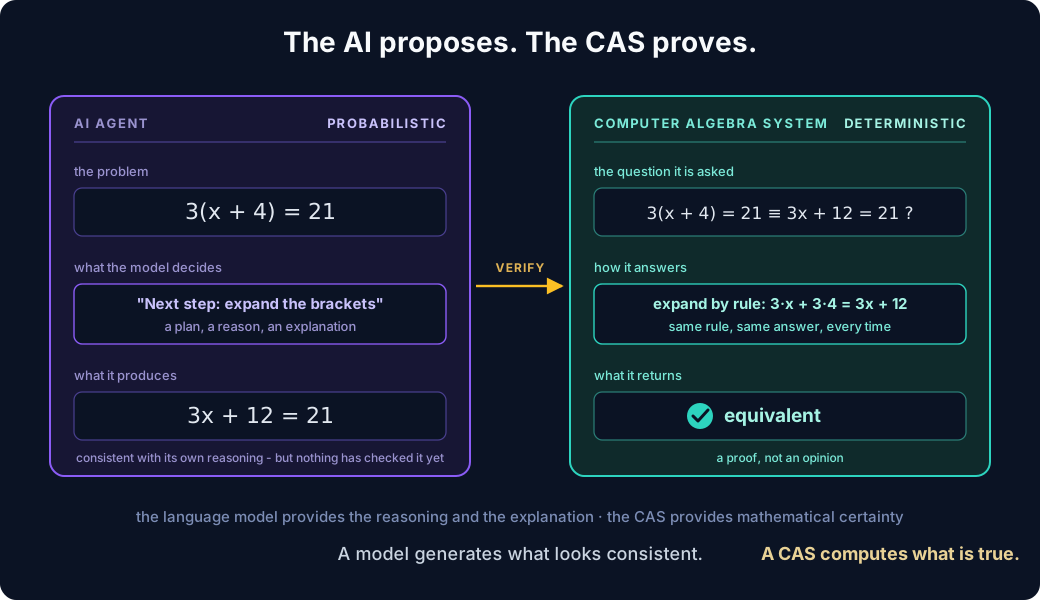
The AI proposes. The CAS proves.
For example, an agent might decide that the next step in solving
3(x + 4) = 21
should be to expand the expression.
A CAS can verify that
3x + 12 = 21
is mathematically equivalent to the original equation.
The language model provides the reasoning and the explanation. The CAS provides mathematical certainty.
What a CAS actually is
A Computer Algebra System - Mathematica, Maple, SymPy, Maxima, the engine inside a graphing calculator - manipulates symbols, not just numbers. Give it 3(x + 4) and it can expand, factor, simplify, solve, differentiate or substitute, and it can tell you whether two expressions are the same thing written differently. Every operation follows a rule. Run it twice and you get the same answer twice.
Determinism becomes more valuable as agents gain autonomy
Traditional chatbots usually respond to one prompt at a time.
Agents are different. An agent might perform dozens of operations during a single task:
Goal → Plan → Tool calls → Calculations → Decisions → More tool calls → Final answer
Each step introduces the possibility of error. A small mathematical mistake early in the chain can influence every decision that follows.
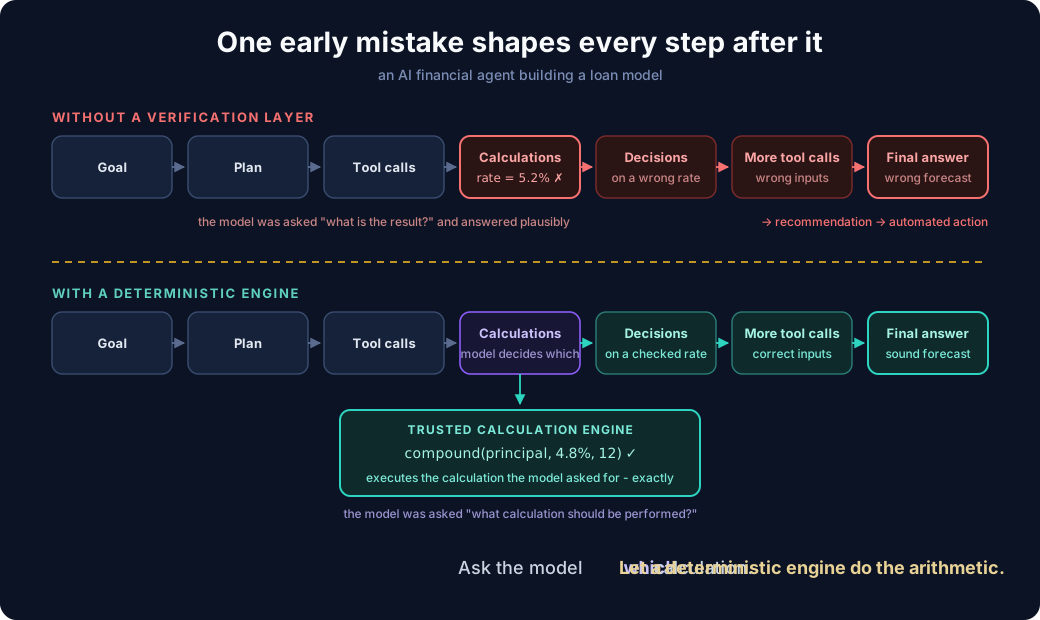
Consider an AI financial agent calculating a loan model. If the agent incorrectly calculates an interest rate, or compounds a value incorrectly, that error may flow into forecasts, recommendations and automated actions.
A deterministic calculation engine creates a validation layer.
Instead of asking the model:
What is the result?
the system asks the model:
What calculation should be performed?
The calculation itself is then executed by a trusted engine.
This distinction becomes extremely important as AI systems move from generating answers to taking actions. It is the same principle traced in the model is not your agent: use intelligence for uncertainty, use software for certainty. Mathematics is about as certain as a step gets.
Agents should orchestrate tools, not replace them
One of the misconceptions around AI is that sufficiently powerful language models will eventually replace specialised software.
A more practical architecture is emerging. The agent becomes an orchestrator. It determines which specialised system should perform each task.
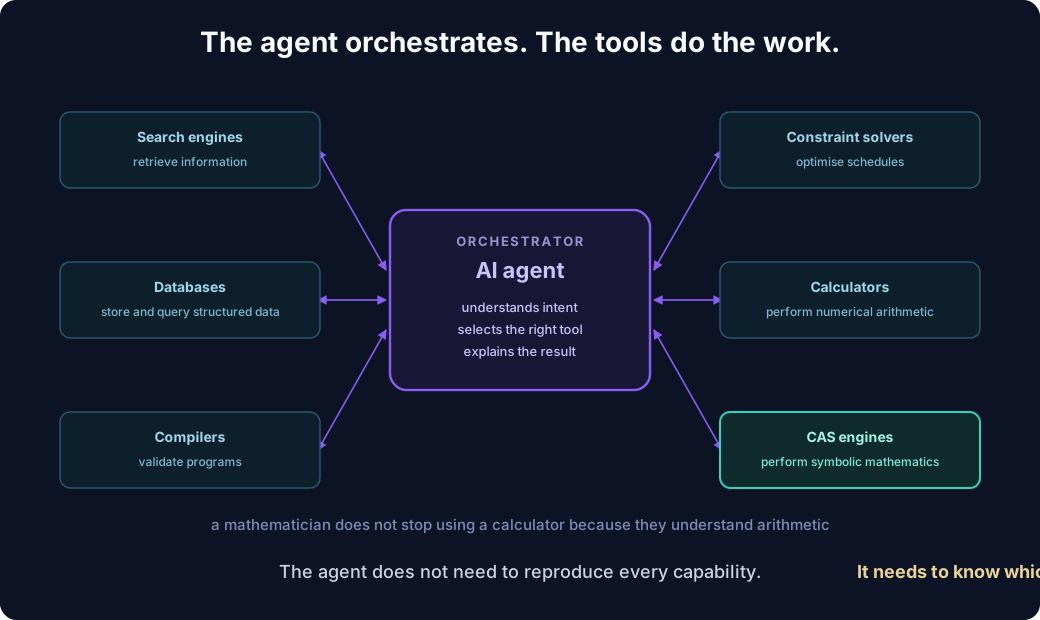
For example:
- Search engines retrieve information.
- Databases store and query structured data.
- Compilers validate programs.
- Constraint solvers optimise schedules.
- Calculators perform numerical arithmetic.
- CAS engines perform symbolic mathematics.
The AI provides flexibility around these systems. It understands intent, selects tools and explains results. But it does not need to reproduce every capability internally.
This is similar to how humans work.
A mathematician does not stop using a calculator because they understand arithmetic. An engineer does not stop using simulation software because they understand physics.
Tools provide reliability and scale. AI agents should use them in the same way.
CAS can act as a mathematical guardrail
One of the most useful roles for a CAS in an agentic system is verification.
Imagine an AI tutoring system. The learner writes:
2(x + 3) = 14
and then says:
2x + 3 = 14
A language model may recognise the mistake. But instead of relying entirely on probabilistic reasoning, the platform can ask the CAS one precise question:
Are these two expressions equivalent?
They are not.
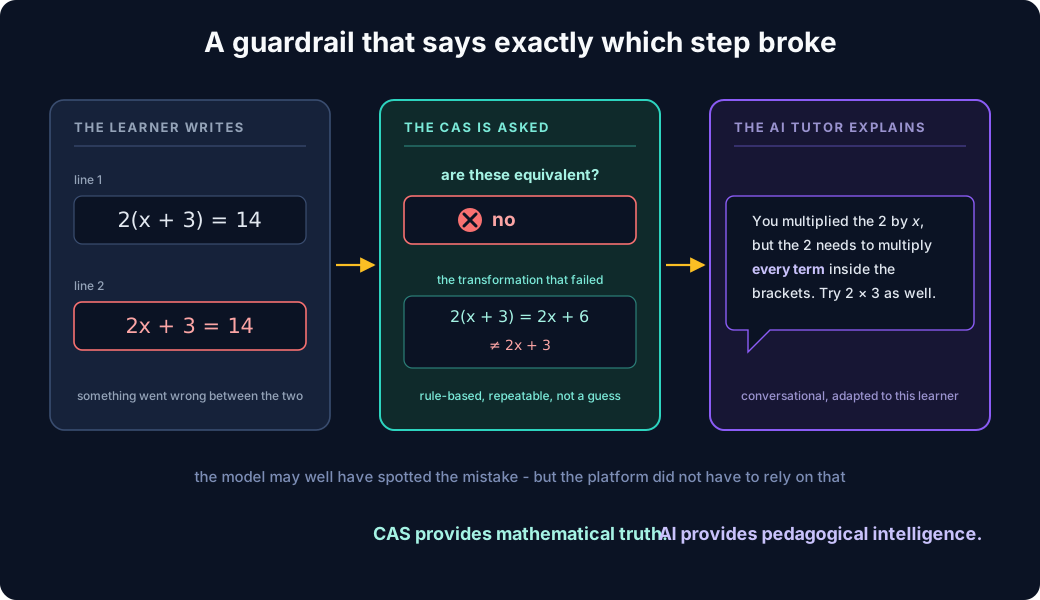
The system can then identify the specific transformation that failed:
2(x + 3) = 2x + 6
And the AI can explain the misconception conversationally:
You multiplied the 2 by x, but the 2 needs to multiply every term inside the brackets.
This architecture combines two very different strengths.
The CAS provides mathematical truth. The AI provides pedagogical intelligence.
That combination is significantly stronger than either system alone.
The most powerful pattern is neuro-symbolic
This approach is sometimes described as neuro-symbolic computing.
Neural systems such as language models are excellent at dealing with ambiguity, language, context and flexible reasoning. Symbolic systems excel at rules, constraints and formal verification.
Combining the two allows each system to operate where it is strongest.
A simplified architecture might look like this:
Student question
      ↓
AI agent   - understand the problem
      ↓
AI agent   - select a mathematical strategy
      ↓
CAS        - perform or verify the transformations
      ↓
AI agent   - interpret the result
      ↓
Tutor      - explain the concept to the learner
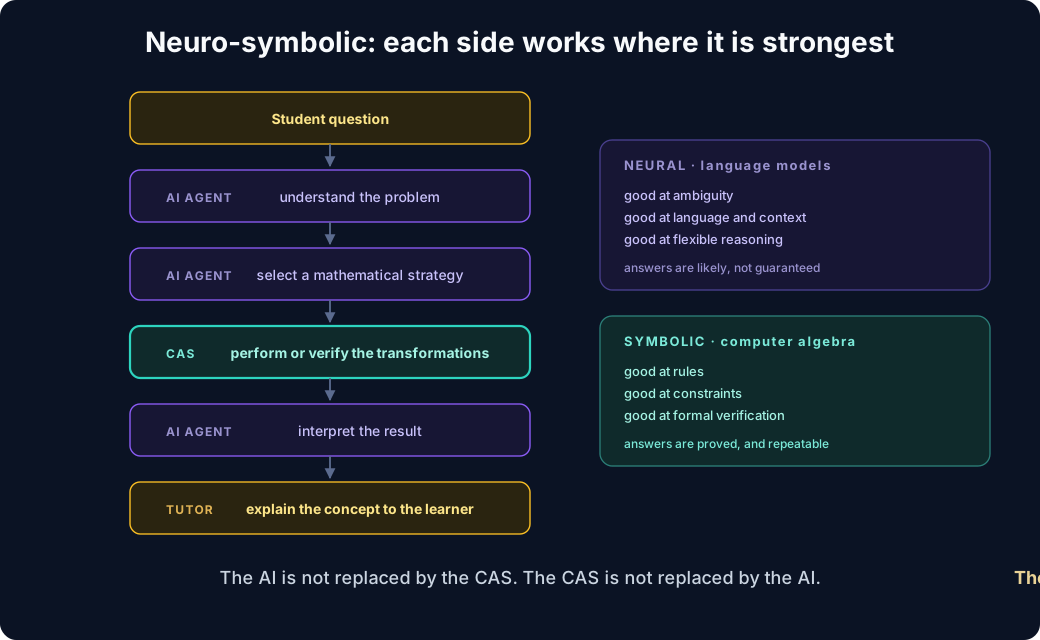
The AI is not replaced by the CAS. The CAS is not replaced by the AI.
They become complementary components.
Do not let the model grade its own homework
The tempting shortcut is to have the model check its own algebra: "verify your answer before responding." That is the same probabilistic process reviewing its own output, and it fails in correlated ways - the reasoning that produced a wrong step tends to find that step convincing. Verification has to come from something that computes differently. That is what the symbolic side is for.
CAS also improves explainability
Verification is only one benefit.
A CAS can also provide a structured mathematical trace. For example:
3x + 6 = 18
    subtract 6 from both sides
3x = 12
    divide both sides by 3
x = 4
An agent can use these transformations as evidence when constructing its explanation.
This is particularly valuable in education, because the important question is often not simply:
Did the student get the correct answer?
It is:
Which mathematical step did the student misunderstand?
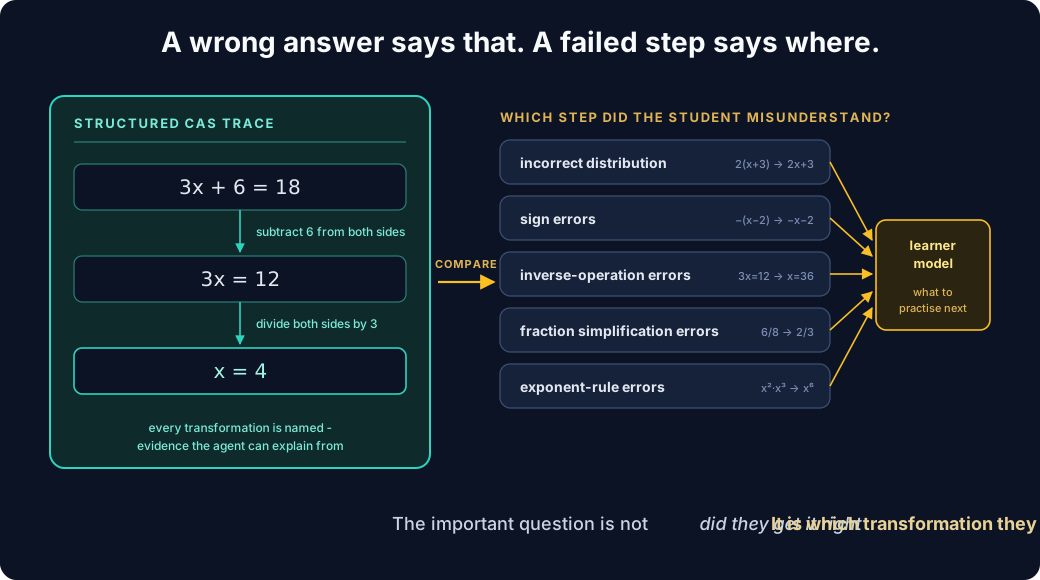
A system that understands transformations can distinguish between different misconceptions:
- incorrect distribution,
- sign errors,
- inverse-operation errors,
- fraction simplification errors,
- exponent-rule errors.
That information can then feed a learner model and influence what the student should practise next.
A wrong answer tells you that something went wrong. A failed transformation tells you where.
It also reduces the cost of using AI
There is another practical benefit.
Not every mathematical operation requires an LLM.
Suppose an educational platform needs to generate and validate thousands of practice questions. Using a language model for every calculation would be unnecessarily expensive, and slower than it needs to be.
A better architecture might use:
Deterministic engine → the default
LLM                  → when interpretation or explanation is required
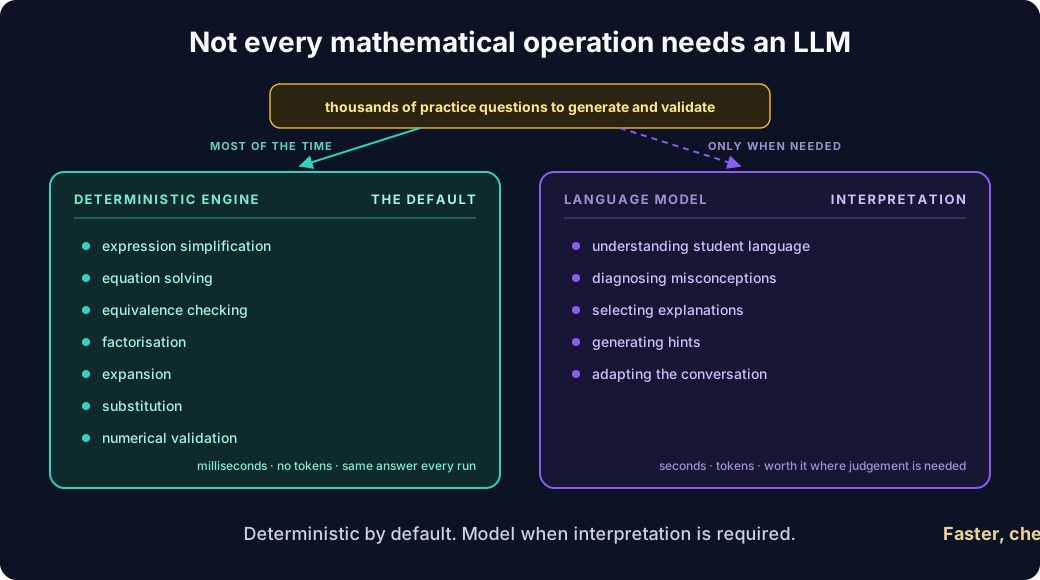
The deterministic layer can handle:
- expression simplification,
- equation solving,
- equivalence checking,
- factorisation,
- expansion,
- substitution,
- numerical validation.
The LLM can focus on:
- understanding student language,
- diagnosing misconceptions,
- selecting explanations,
- generating hints,
- adapting the conversation.
The result can be faster, cheaper and more reliable. This is the same split the agentic patterns post keeps returning to: most of what a production agent does should be a cheap, deterministic stage, with the model reserved for the parts that genuinely need judgement.
The future is not AI versus traditional software
The rise of AI often creates an assumption that existing technologies will disappear.
But computing rarely evolves that way.
Databases did not disappear when search engines appeared. Compilers did not disappear when coding assistants arrived. Calculators did not disappear when spreadsheets became common.
Instead, new layers of abstraction emerge.
Agentic AI is likely to become another such layer.
The agent understands the goal. Specialised tools perform the operations. Deterministic systems verify important results. And the agent combines those outputs into something useful for the user.
CAS may matter more when AI becomes more powerful
As AI agents become more capable, they will increasingly operate systems rather than simply answer questions.
That means reliability becomes more important, not less.
For mathematics, a Computer Algebra System provides something a language model cannot guarantee on its own:
formal, repeatable and deterministic mathematical verification.
The most interesting future therefore isn't:
AI replacing CAS.
It is:
AI knowing when to call CAS.
That is a broader lesson for agentic software, and it scales all the way up: the model is no longer the architecture makes the same argument for the whole engineering stack, where deterministic systems sit beside the harness, the policy engine and the control plane.
The smartest agent may not be the one that tries to know everything.
It may be the one that knows which tools to trust, when to use them, and how to verify its own reasoning.